Google Serper API is a third-party Google Search API used to retrieve search engine results in a structured format. For SEO teams, this type of tool is useful because Google search results change by keyword, location, language, device, and time. Manually checking those results is slow, inconsistent, and difficult to scale.
For developers, a SERP API can return search data to internal tools, dashboards, AI agents, or reporting systems. For marketers and non-technical users, the bigger question is different: how can SERP data become clean, usable SEO insight? That is where a structured workflow matters. CoreClaw’s Google Search Results Scraper API is designed to return structured SERP summaries, including search parameters, organic results, related queries, and People Also Ask data.
What Is Google Serper API?
Google Serper API is commonly used as a third-party API for accessing Google search result data programmatically. Public product pages position it around Google Search API access, with result types such as Search, Images, News, Maps, Places, Videos, Shopping, Scholar, Patents, and Autocomplete.
In simple terms, an API is a way for software tools to talk to each other. Instead of opening Google in a browser and copying results manually, a developer sends a search request and receives a structured response that can be stored, analyzed, or passed into another system.
This matters for SEO because SERP data is not only about rankings. It can include organic results, snippets, related searches, People Also Ask questions, knowledge panels, news results, local results, and other search features. These signals help SEO teams understand what Google is showing for a topic and what type of content users are likely expecting.
Why SEO Teams Use SERP APIs
SEO teams use SERP APIs because search results are dynamic. A keyword may show different results in the United States, the United Kingdom, or Australia. A query may show different intent depending on whether it triggers ecommerce pages, local packs, blog posts, videos, or comparison pages.
A SERP API helps teams collect this data repeatedly. That makes it useful for rank tracking, competitor monitoring, content planning, and market research. It can also help SaaS teams and agencies build reporting dashboards instead of manually checking dozens or thousands of keywords.
There is also a broader market reason. Google’s official Custom Search JSON API is not a full general-purpose SEO rank tracking solution, and Google states that the Custom Search JSON API is closed to new customers, with existing customers expected to transition before January 1, 2027. This is one reason many SEO and data teams look at SERP data platforms or web scraping workflows when they need broader search result visibility.
Google Serper API Use Cases for SEO
Keyword and SERP Monitoring
The most common use case is keyword tracking. SEO teams can collect the top results for target keywords and check how rankings change over time.
For example, a SaaS company may monitor keywords such as “best lead generation tools,” “web scraping API,” or “Amazon product scraper.” A simple ranking report may show who appears in the top 10. A better report also captures page titles, snippets, domains, result types, People Also Ask questions, related queries, and collection time.
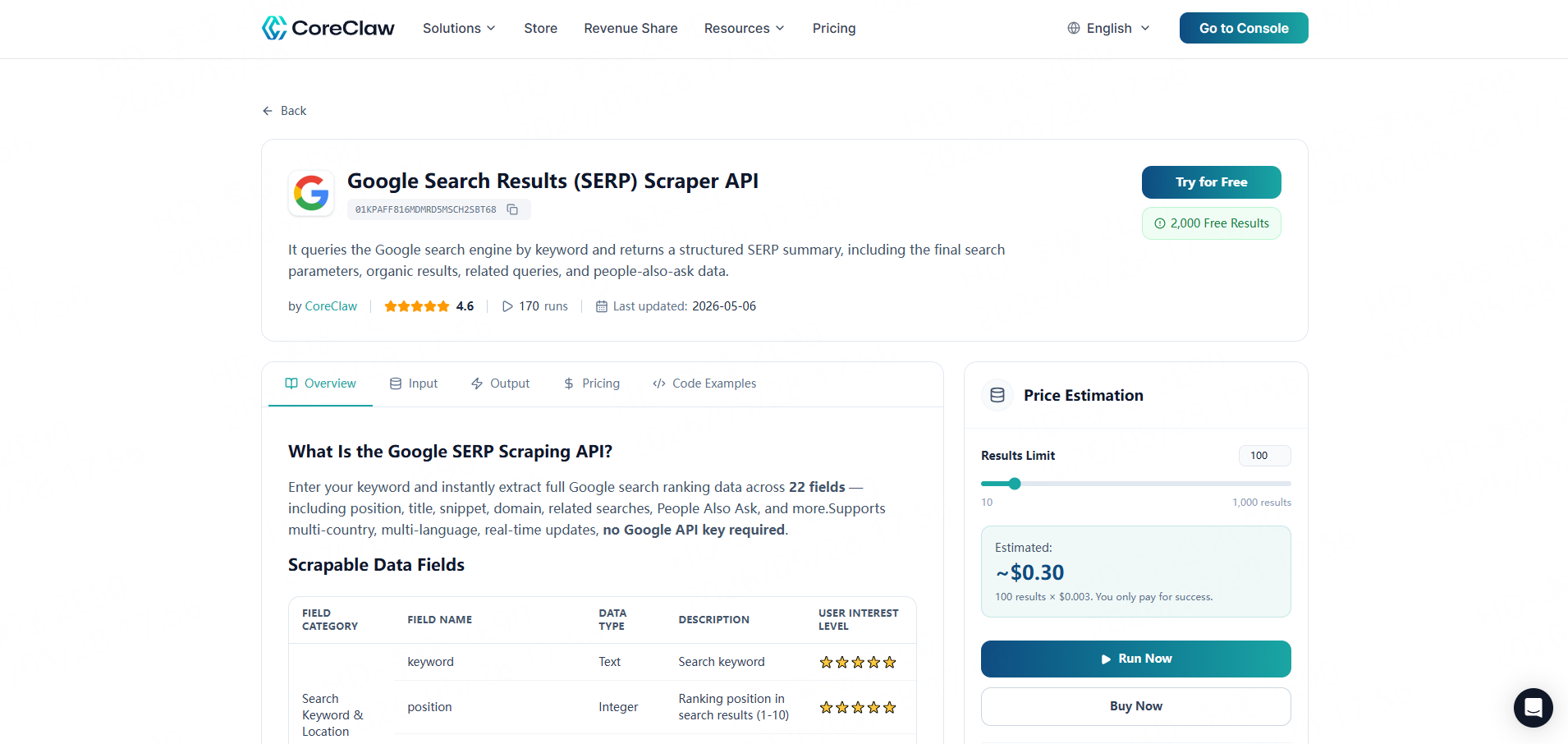
CoreClaw’s Google Search Results Scraper API supports fields such as position, title, snippet, root domain, related queries, People Also Ask, country, language, geolocation, and scraped timestamp, which makes the output more useful for SEO reporting and trend analysis.
Competitor Visibility Tracking
SERP APIs are useful for tracking competitor visibility. Instead of only asking “where do we rank?”, teams can ask:
- Which competitors appear most often?
- Which domains own the top positions?
- Which pages are winning informational searches?
- Which brands appear in People Also Ask or related searches?
- Which result types are becoming more common?
This helps SEO teams move beyond simple rank tracking. A competitor may not outrank every keyword, but it may dominate a cluster of high-intent searches. Structured SERP data makes those patterns easier to find.
People Also Ask and Related Query Research
People Also Ask and related searches are valuable for content planning because they show how users phrase questions around a topic.
For example, a keyword like “Google Serper API” may connect to questions about pricing, alternatives, Google Search API access, SEO automation, rank tracking, and JSON output. A content team can use these questions to plan H2 sections, Frequently Asked Questions, comparison pages, and support articles.
CoreClaw is useful here because its Google SERP Scraper can return related queries and People Also Ask data as structured output, instead of forcing teams to copy questions manually from search pages.
Content Gap Analysis
SERP data helps teams understand what top-ranking pages cover. If every top result includes API examples, pricing notes, limitations, JSON output, and alternatives, then a thin article that only defines the tool may not be enough.
A practical content gap workflow looks like this:
- Collect SERP results for 20–50 related keywords.
- Export titles, snippets, domains, ranking positions, and questions.
- Group pages by search intent.
- Identify repeated themes and missing angles.
- Build a content outline that answers the search intent more completely.
AI and SEO Research Workflows
SERP APIs are increasingly used with AI systems. Developers may feed search results into AI agents for research, summarization, content briefs, or market intelligence. Serper’s public positioning highlights use cases such as AI chatbots, SEO analytics, and fintech projects.
However, AI workflows need clean inputs. Raw or noisy search data can lead to weak summaries, missing context, or duplicated insights. Before SERP data is used in AI research, teams should filter irrelevant results, keep timestamps, separate organic results from ads or special features, and validate important findings manually.
Key Limits of Google Serper API
Google Serper API can be useful, but it is not a complete SEO platform by itself.
First, it is not Google’s official Search Console data. It can help collect public search results, but it does not replace impressions, clicks, indexing status, or page performance data from Google Search Console.
Second, SERP data changes often. A result collected today may not match tomorrow’s results. Location, language, personalization, device type, and search features can all affect what appears.
Third, API output still needs analysis. A SERP API can return titles, links, snippets, or result features, but it does not automatically decide which content strategy is best. SEO teams still need to interpret the data.
Fourth, developers may need to build storage, dashboards, alerts, deduplication, and data cleaning around the API. This can be fine for engineering teams, but it may be too much for marketing teams that mainly need clean exports.
Finally, compliance and responsible use matter. Teams should focus on publicly available search result data, avoid collecting sensitive or restricted information, and review applicable rules before building large-scale workflows.
Google Serper API vs Google SERP Scraper
Google Serper API is a strong fit for developers who want direct API access to Google-style search results and are comfortable building their own data workflow.
CoreClaw is a better fit when the user wants a ready-made SERP data workflow that is easier to run, export, and review. CoreClaw’s Google Search Results Scraper API lets users enter keywords or Google search URLs, customize location and language settings, and export results in JSON, CSV, or Excel.
Need | Google Serper API | CoreClaw Google SERP Scraper |
Developer API access | Strong fit | Available |
No-code usage | Limited | Strong fit |
CSV/Excel export | Requires workflow setup | Built for export |
SEO research fields | Available through API response | Organic results, position, snippets, related queries, PAA, timestamp |
Business-user workflow | Requires technical setup | Easier for marketers and analysts |
Pricing focus | Query-based API model | Pay only for successful results |
A Practical SERP Data Workflow with CoreClaw
A simple SEO workflow starts with a keyword set. For example, an agency may collect 100 keywords across product pages, comparison pages, local searches, and informational blog topics.
Next, the team runs the Google Search Results Scraper with country, language, and geolocation settings. CoreClaw collects structured SERP data such as ranking position, title, snippet, domain, related queries, People Also Ask, and timestamp. The data can then be exported as CSV or Excel for review, or JSON for developer workflows.
After export, the team can filter the dataset by domain, keyword group, ranking range, question type, or topic cluster. This helps answer practical SEO questions: which competitors appear most often, which topics need better content, which keywords show buying intent, and which pages should be updated first.
For recurring workflows, developers can use API access to connect CoreClaw results with dashboards, internal tools, or reporting systems. For niche SERP or web data requirements, teams can request a custom Worker instead of building a full scraper from scratch.
Final Thoughts
Google Serper API can be useful for developers who need programmatic access to Google search result data. For SEO teams, the value comes from turning that data into repeatable workflows: rank monitoring, competitor visibility tracking, People Also Ask research, content gap analysis, and AI-ready research inputs.
The main limitation is that an API response is not the same as an SEO workflow. Teams still need clean fields, filtering, exports, timestamps, validation, and a practical way to share results.
With CoreClaw, teams can collect structured Google SERP data through ready-made Workers, export results as CSV, Excel, or JSON, connect through API workflows, pay only for successful results, and request custom Workers when needed. For SEO teams that want SERP data without turning every project into an engineering task, CoreClaw provides a practical path from Google search results to ready-to-use insights.
Frequently Asked Questions

Content Writer @CoreClaw · Last Updated 2026-06-03
Lena Kovalenko researches how modern software systems expose and organize information online. Her writing focuses on the interaction between APIs, web platforms, and automated data workflows. When exploring a topic she typically compares multiple tools to understand their design assumptions. These comparisons often lead to articles that help readers see how different technical approaches influence reliability and efficiency.
View Author Profile →Disclaimer: All information on the CoreClaw Blog is provided “as is” and for informational purposes only. CoreClaw makes no representations and assumes no liability for any consequences arising from your use of information published on the CoreClaw Blog or on any third-party websites linked from it. Before any scraping activity, consult legal counsel, review the target website’s terms of service, and obtain permission where required.