In a business environment where data-driven decision-making has become the norm, companies increasingly rely on high-quality data to support growth and strategic planning. With the rising importance of video content platforms, YouTube channels have become a key window for understanding user interests and market trends. To meet this growing demand, more and more service providers now offer YouTube scraping solutions. This article will provide a systematic comparison of the best-performing YouTube channel scraper tools in 2026, helping you understand the strengths and ideal use cases of different approaches.
What is YouTube channel data used for?
In today’s rapidly growing digital content environment, YouTube channel data has become an essential foundation for understanding user behavior and content trends. By effectively leveraging this data, we can develop more precise marketing strategies and content directions.
1. Market trend analysis
By using youtube scraping techniques to collect channel content and view trends, it is possible to identify industry hotspots and shifts in user interest. Companies can optimize product selection and content strategies based on these insights.
2. Competitor analysis
By collecting competitor channel data, we can analyze their posting frequency, video structure, and engagement performance, helping us understand their growth logic and audience acquisition strategies. By comparing different channels, we can further optimize our own content strategy.
3. Potential customer discovery
YouTube channel data reflects user preferences, viewing habits, and interaction behaviors. This information helps build more refined audience models and improves content matching accuracy.
4. Content performance optimization
Through scraping data from YouTube, such as watch time and engagement rate, we can determine which types of videos are more likely to generate clicks and conversions. Based on these insights, content structure and presentation can be continuously optimized.
5. Brand influence monitoring
Comments and engagement data related to a channel reflect how users truly perceive a brand. This provides important insights for timely adjustments in brand communication strategy.
How to choose the best YouTube channel scraper tool?
In today’s data-driven environment, tool selection is no longer just about feature comparison, but about aligning with real business needs. A suitable tool that can stably support the data pipeline can significantly improve overall efficiency.
We should evaluate from the following dimensions:
● Data coverage and structural capability
Whether a tool can fully capture core fields such as channels, videos, and comments is the basic criterion for practical value. Especially when using a youtube channel scraper for data collection, completeness of fields directly impacts downstream usability and business scalability.
● Stability and performance over time
In long-running tasks, system stability directly determines whether data is continuous and reliable. This is especially critical in youtube scraping, where interruptions or missing data can affect overall analysis and business rhythm.
● User experience and learning cost
Ease of use directly impacts team efficiency, especially in collaborative environments. Some youtube scraping tools offer rich features, but if they are too complex or require long learning cycles, actual productivity will decrease.
● Automation and task management
Whether batch execution and scheduling are supported directly affects scalability. In many youtube scraping scenarios, automation reduces repetitive work and improves operational efficiency.
● Extensibility and integration
Whether a tool can integrate with external systems determines its adaptability in complex workflows. In youtube web scraping processes, strong extensibility ensures smoother data flow and higher long-term value.
Top YouTube channel scraper tools
CoreClaw
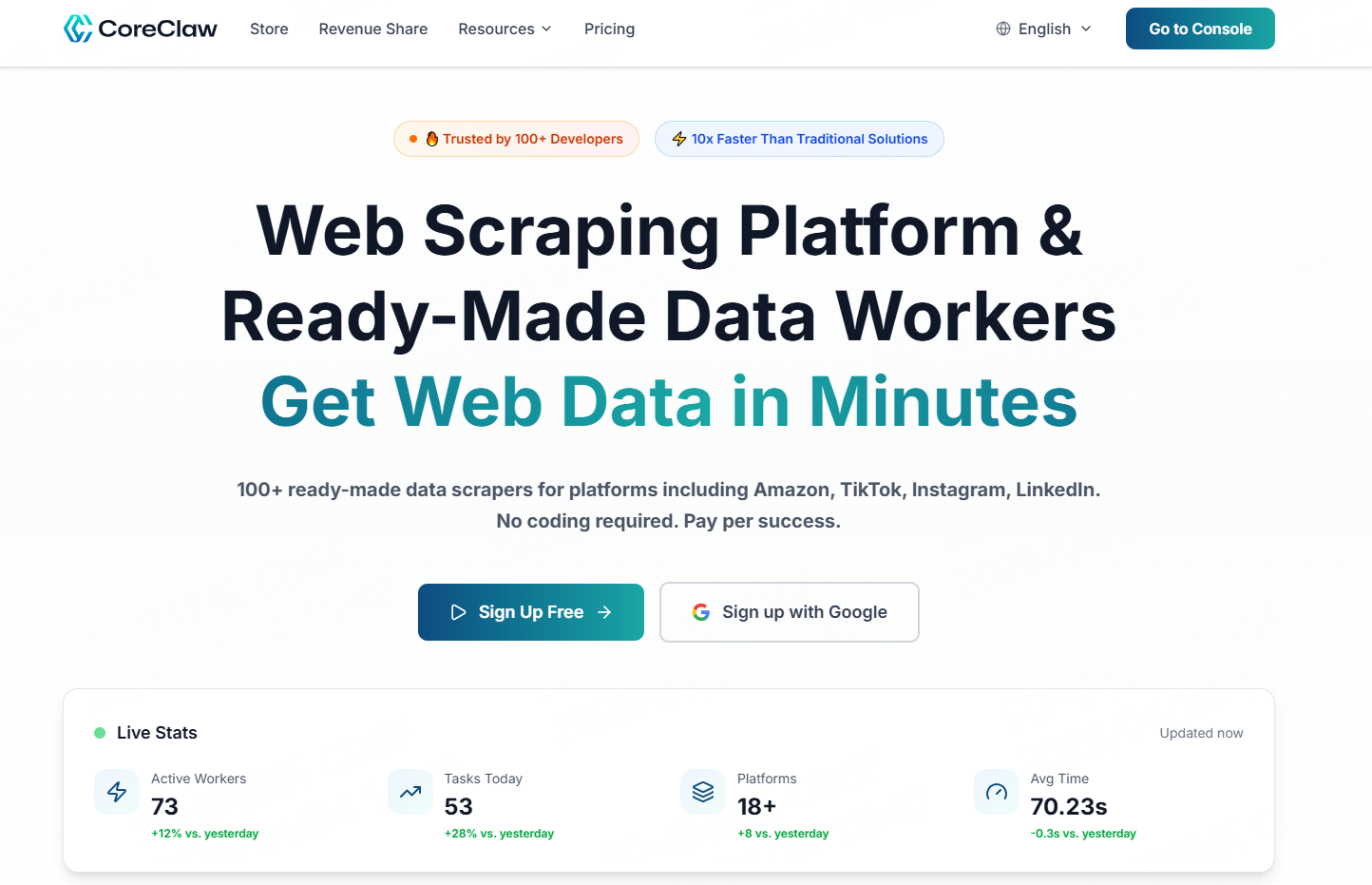
CoreClaw is an automated web scraping platform designed for multi-scenario data needs. Its core service is providing reusable and scalable data collection tools for businesses and developers. Through pre-built workers and a cloud execution environment, the platform standardizes complex data acquisition processes, enabling users to complete large-scale data tasks more efficiently. Its services cover multiple industries, including e-commerce, social media, and market research, and improve efficiency through unified APIs and automated scheduling. It provides multiple scraping tools for YouTube data collection, including channel scraper, comment scraper, data scraper, and search results scraper.
Features:
● 200+ ready-to-use worker templates allow users to quickly obtain YouTube channel data by simply entering parameters, without complex configuration.
● Supports multi-platform data collection, including YouTube, Instagram, LinkedIn, Google Maps, Amazon, and Indeed.
● Tasks run in a cloud environment and can be executed and repeated automatically, making data collection seamless and continuous.
● Data can be exported directly in JSON/CSV formats for use in other tools or systems.
Pros:
● No technical background required; fast learning curve suitable for general users.
● Pre-built tools reduce the time cost of building data pipelines from scratch.
● Cloud execution ensures stable task performance without local environment dependency.
Cons:
● A large number of pre-built workers require some time to become familiar with.
Pricing:
● Starting at $29/month
→ New users get 2000 free results
Lobstr.io
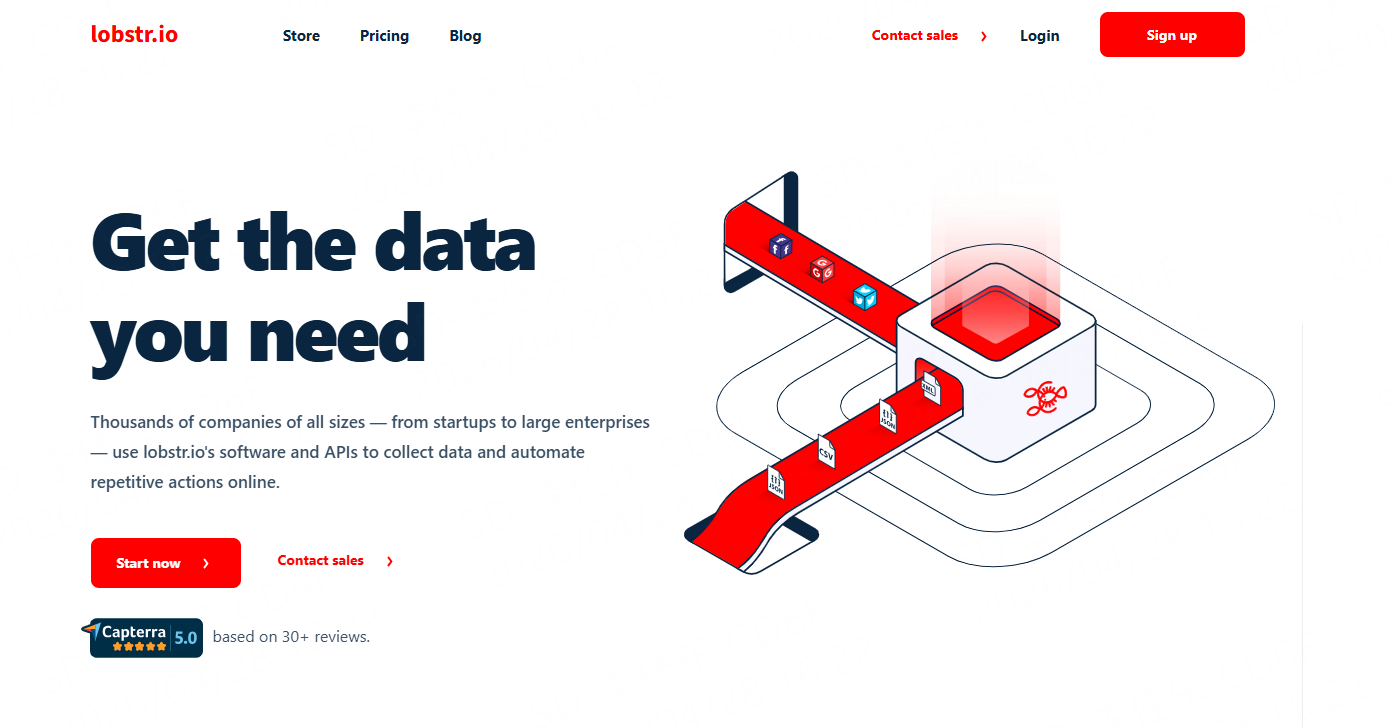
Lobstr.io is an online automation platform for multi-source data collection, helping users quickly complete web data scraping tasks using ready-made tools. It provides pre-configured tools covering social media, e-commerce, and mapping data sources, focusing on a “quick start + visual operation” experience.
Features:
● No coding required; data scraping workflows can be built through a visual interface.
● Supports scheduled task execution to reduce repetitive manual work.
● Supports multi-source data extraction from websites and platforms.
Pros:
● Easy for beginners to understand and start using.
● Automates repetitive tasks effectively.
● No programming knowledge required.
Cons:
● Less flexible compared to developer-focused scraping tools.
● Limited when dealing with highly complex data structures.
● Some data sources may be restricted or unstable.
● Costs may increase with large-scale usage.
Pricing:
● Starting at $20/month
Apify
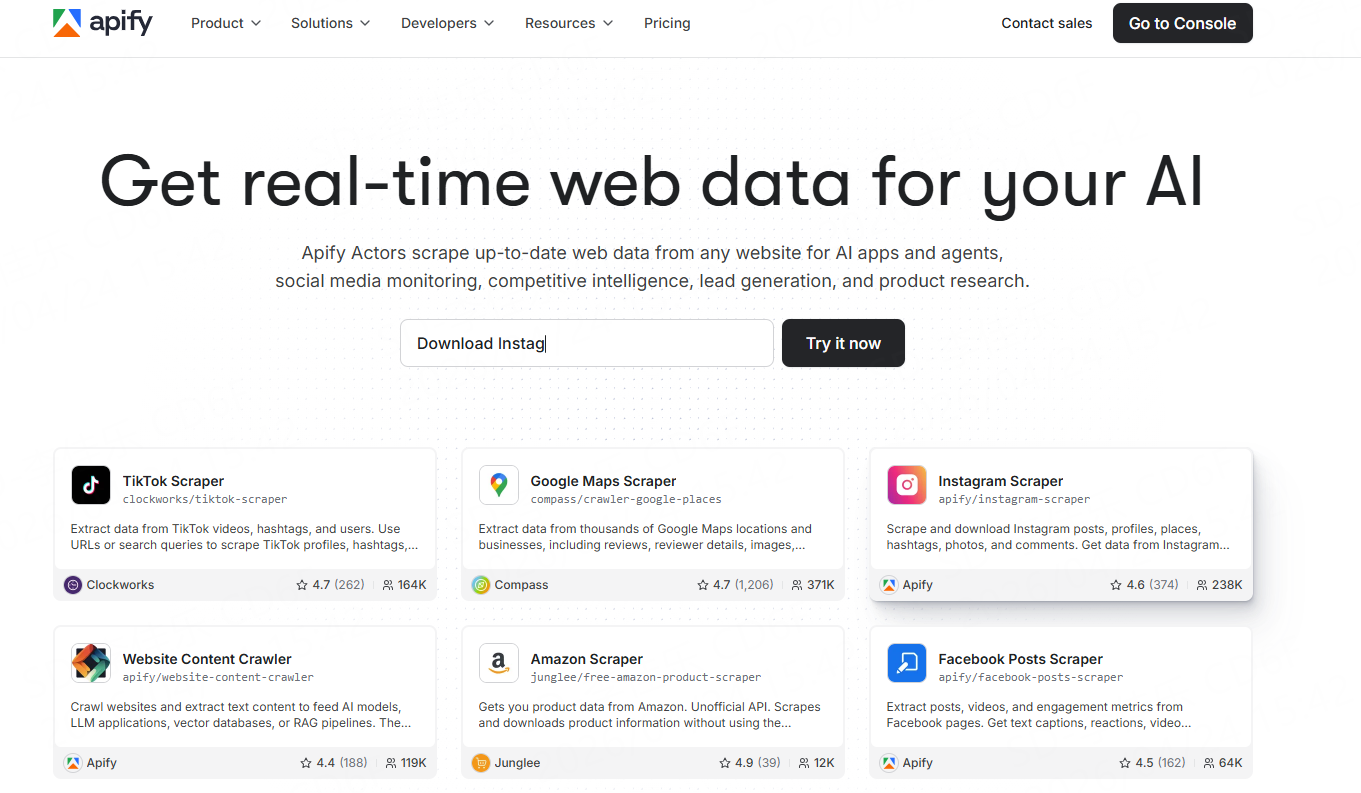
Apify is a cloud-based web data automation and scraping platform designed to help users extract structured data from websites and simplify complex data workflows. It offers a large number of ready-made “Actors” that users can directly use or customize for different data needs.
Features:
● Ready-made Actors for direct website data extraction.
● Cloud-based execution with all scraping processes running on servers.
● Supports automation such as scheduling and recurring tasks.
Pros:
● Large library of tools with many ready-made solutions.
● No need to manage servers or complex environments; easy to start.
● Strong automation capabilities suitable for long-term tasks.
Cons:
● Costs may increase quickly with advanced usage or large-scale tasks.
● Quality of ready-made tools varies; some may be poorly maintained.
● Initial learning curve for beginners.
● Requires technical ability for highly customized scenarios.
Pricing:
● Starting at $29/month
PhantomBuster
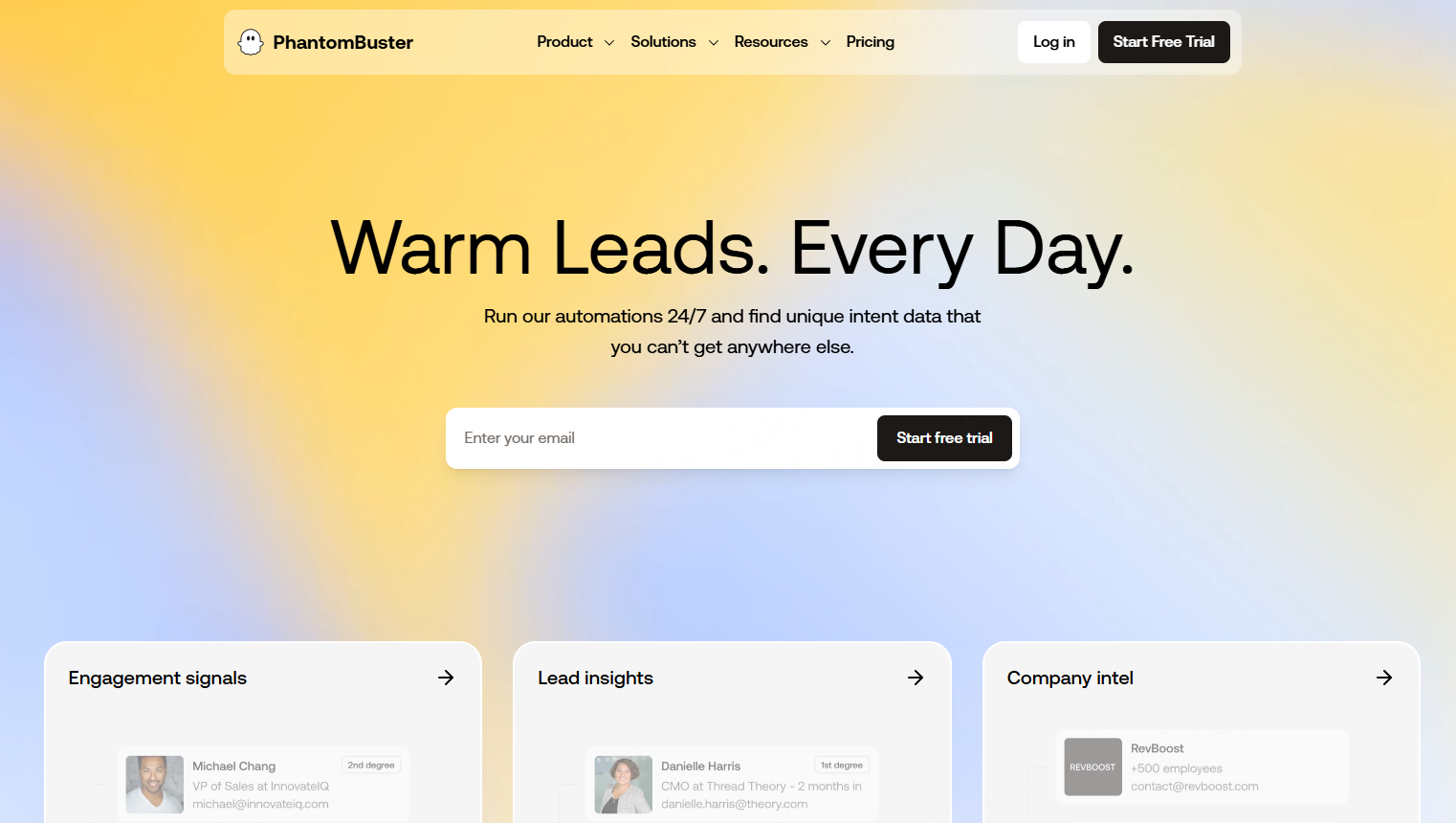
PhantomBuster is a cloud-based automation platform that enables users to perform data scraping and outreach automation without coding. It supports lead generation, social media data collection, and automated messaging across platforms like LinkedIn, Instagram, Google Maps, and Twitter.
Features:
● Supports data extraction from multiple platforms including social media and search engines.
● Provides pre-built automation workflows ("Phantoms").
● Can sync data to CRMs or spreadsheets.
Pros:
● Large library of ready-made automation tasks.
● Multi-platform support for diverse use cases.
● Suitable for sales and growth teams.
Cons:
● Limited flexibility in complex or highly customized scenarios.
● Requires adaptation to platform logic.
● Costs may increase with scale.
● Depends on external platform stability.
Pricing:
● Starting at $56/month
Octoparse
Octoparse is a no-code web scraping tool that uses a visual interface to help users extract structured data from websites. It is suitable for non-technical users in market research, e-commerce analysis, and data collection.
Features:
● Visual workflow builder using click-based element selection.
● Cloud execution for continuous background data collection.
● Supports dynamic web pages (pagination, scrolling, etc.).
Pros:
● No coding required to get started quickly.
● Rich templates reduce setup time.
● Good support for dynamic websites.
Cons:
● Limited flexibility for complex customization.
● Learning curve for workflow structure.
● Advanced features can be hard for beginners.
● Costs increase with long-term large-scale use.
Pricing:
● Starting at $69/month
YouTube channel scraper: Comparison table
Tool | Type | Difficulty | Usage Method | Data Coverage | Automation | Flexibility | Integration | Use Case |
CoreClaw | No-code scraping platform | Low | 200+ ready-made workers | Medium–High | High | Medium | Medium | Bulk data tasks |
Lobstr.io | Lightweight data tool platform | Low | Ready-made tools | Medium | Medium | Low | Medium | Basic data collection |
Apify | Developer cloud platform | Medium | Ready-made actors | High | High | High | High | Complex system-level scraping |
PhantomBuster | Automation growth tool | Medium | Workflow automation | Medium | High | High | Medium–High | Marketing automation |
Octoparse | Visual scraping tool | Low | Drag-and-drop UI | High | Medium | Medium | Medium | Visual web scraping |
YouTube channel scraper: Decision tree
When choosing a tool, decisions should be based on business goals rather than feature comparisons alone. Different youtube scraper tools vary significantly in use cases.
● Do you need "no-code fast setup"?
○ ✅️ → Simple path
○ ❌️ → Advanced path
● Simple path:
○ Focus on basic data collection?
✅️ Yes → Lobstr.io / Octoparse
❌️ No → CoreClaw
● Advanced path:
○ Need automation or growth workflows?
✅️ Yes → PhantomBuster
○ Need developer-level flexibility?
✅️ Yes → CoreClaw
● For stable long-term YouTube data collection:
○ CoreClaw or Octoparse
● For cross-platform automation growth:
○ PhantomBuster
● For highly customized system integration:
○ Apify
Conclusion
When evaluating different youtube channel scraper tools, it is clear that each product has a distinct positioning: some focus on low entry barriers and ease of use, others emphasize flexibility and extensibility, while others are better suited for long-term automation or complex system integration. As real-world usage increasingly prioritizes stability, sustainability, and low maintenance cost, tool selection is no longer just about features, but about whether it can reliably support daily data workflows over time.
CoreClaw stands out in this context with a more balanced approach. By simplifying workflows through workers and leveraging cloud execution capabilities, it achieves a strong balance between usability and stability. This allows teams to focus more on data insights rather than tool maintenance, making it often a preferred choice in overall practical usage.
Frequently asked questions

Last Updated · 2026-05-09 · 6 min read
免责声明:本文观点仅代表作者,不构成任何商业承诺。
查看作者资料 →