As the cost of acquiring customers in the real estate industry continues to rise, businesses are rethinking how they generate realtor leads. Traditional methods such as cold calling, paid advertising, and offline prospecting are limited in efficiency and struggle to scale consistently. Today, with automated web scraping technology, companies can quickly access publicly available real estate agent information, property data, and local market insights, enabling them to build a more stable lead generation system. For real estate marketing and sales teams, this approach has become a more efficient path to growth.
What is Realtor Leads Scraping?
Realtor leads scraping—in essence, is the process of using automated tools to batch extract publicly available real estate agent information, property listings, and contact details from real estate websites, and organizing them into structured data lists that can be used for sales development. Compared with manually browsing page by page, this approach saves a significant amount of time while improving data update efficiency.
Today, many companies are not only focused on simple data collection, but also on how to continuously obtain high-quality realtor leads. Especially in an increasingly competitive local real estate market, relying solely on advertising is no longer enough to ensure stable customer acquisition. Automated data scraping helps teams quickly build regional agent databases and continuously update potential customer resources.
Before moving forward, we need to clarify a commonly misunderstood issue: what is the difference between Realtor Leads and real estate data.
Realtor Leads vs Real Estate Data
● Realtor leads focus more on agent contact information, business regions, and customer acquisition value.
● Real estate data typically includes property prices, listings, transaction history, and market trends.
● Leads are more suitable for sales teams to directly develop clients.
● Real estate data is more suitable for market analysis and business research.
● Realtor leads usually require higher data update frequency.
Manual Prospecting vs Web Scraping
● Manual search typically only allows a small number of contacts to be collected per day.
● Automated web scraping can quickly cover multiple cities and websites.
● Manual recording is prone to missing data and inconsistent formatting.
● Web scraping outputs structured data in a unified format.
● Manual prospecting depends heavily on individual time investment.
● Automated methods are more suitable for long-term and continuous scaling.
Why Businesses Scrape Realtor Leads?
More and more companies are focusing on realtor leads scraping, not because it is “technologically advanced,” but because it truly solves efficiency problems in real estate customer acquisition. Compared with traditional channels, automated data acquisition can help identify target agents faster and reduce the upfront filtering cost for sales teams.
1. Real Estate Prospecting at Scale
One of the biggest challenges for many sales teams is not the lack of ability to develop clients, but the lack of new customer sources. Through web scraping, companies can continuously obtain realtor leads from different regions and expand customer coverage.
For teams searching for best leads for realtors, large-scale data collection can significantly improve acquisition speed.
2. Building Local Realtor Databases
Local real estate markets rely heavily on regional resources, so building city-level agent databases is essential.
Companies can organize contacts based on ZIP codes, cities, property price ranges, and other conditions to form long-term updated data assets.
3. Competitive Market Intelligence
In addition to lead generation, data scraping also helps companies understand competitive market dynamics. For example, listing update frequency, agent activity levels, and new listings in specific regions can all help optimize sales strategies.
4. Lead Enrichment & CRM Automation
Many companies do not only need contact lists, but also complete customer profiles. Through web scraping real estate data, businesses can automatically sync agent information into CRM systems and continuously enrich customer tags.
5 Best Realtor Lead Scraping Tools
CoreClaw
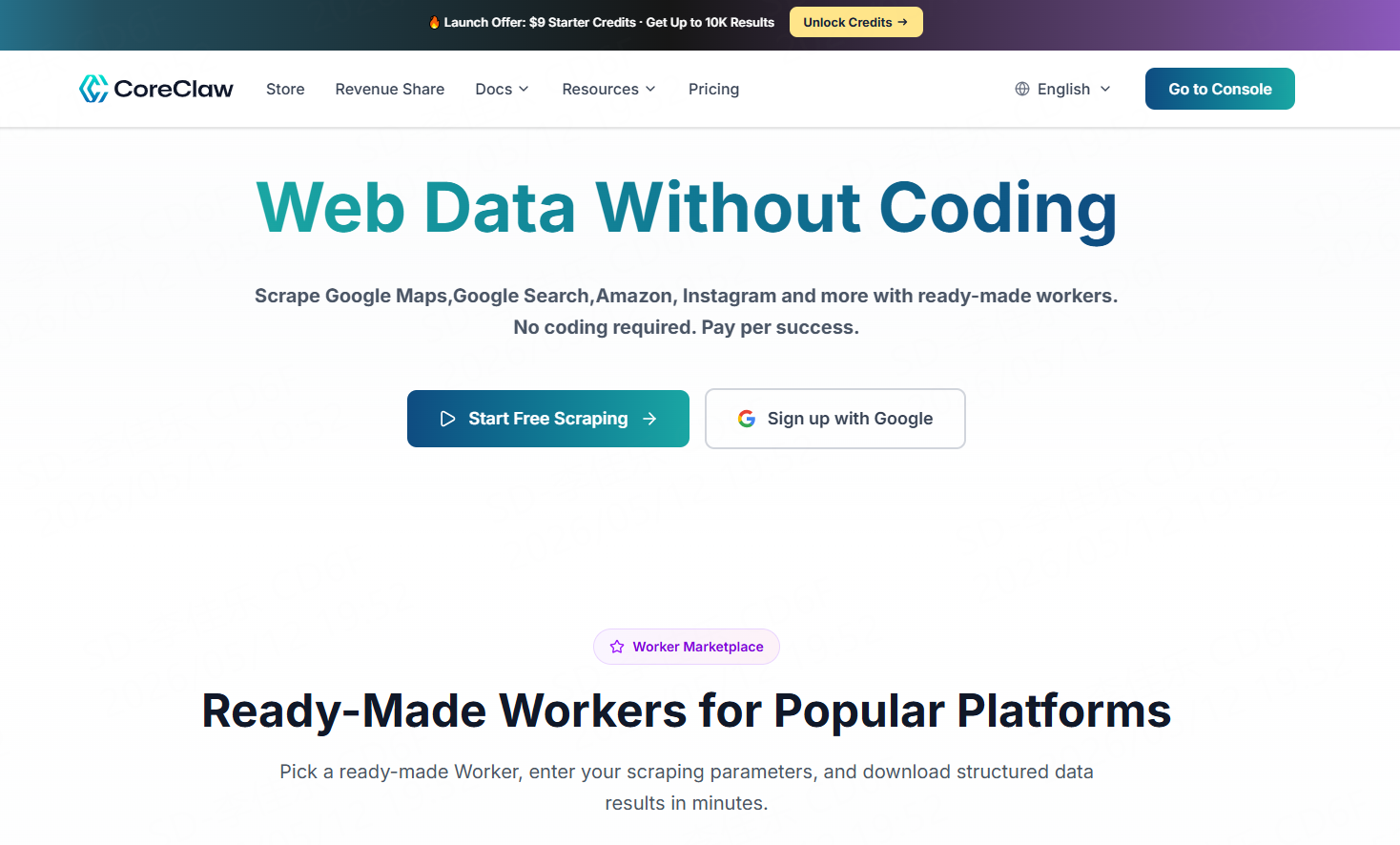
CoreClaw is a full-stack automated web scraping platform designed for enterprise-level data acquisition needs. The platform supports data extraction from multiple websites and provides stable APIs along with visual operation capabilities. In the real estate industry, CoreClaw supports scraping scenarios across platforms such as realtor.com and Zillow, helping businesses quickly obtain realtor leads, property listings, and agent data. Compared with traditional scripting tools, it is more suitable for teams aiming for long-term stable data operations.
Key Features:
● Over 200 ready-to-use workers covering major websites.
● Supports realtor.com scraping and similar scenarios.
● Provides automatic proxy rotation to reduce blocking risk.
● Automatically handles captchas and fingerprint simulation to ensure stable scraping.
● Supports batch task execution and scheduled updates.
● Supports CSV, JSON output formats and API services.
● Provides no-code interface to reduce development barriers.
Cons:
● Large-scale tasks require higher-tier plans.
Apify
Apify is a highly mature automated data collection platform with a rich community ecosystem and a large number of pre-built scraping templates. Many developers use it to quickly build real estate data pipelines. The platform supports cloud execution, so there is no need to maintain local servers.
Key Features:
● Provides a wide range of ready-made Actor templates.
● Supports automated scheduling and cloud execution.
● Can be quickly integrated into API workflows.
● Strong community resources and documentation.
Cons:
● Some advanced templates require additional payment.
● Relatively high learning curve for new users.
● Data cleaning often requires secondary processing.
Python

Python is one of the most common development solutions for real estate data scraping. Many companies use it to build their own automated data systems. With tools such as BeautifulSoup, Scrapy, and Selenium, developers can fully control the data acquisition process and customize fields, rules, and update logic based on business needs.
Key Features:
● High flexibility with fully customizable logic.
● Can handle dynamic pages and JavaScript-rendered content.
● Suitable for building long-term stable real estate data systems.
● Rich ecosystem of scraping and automation libraries.
Cons:
● High learning curve for non-technical teams.
● Requires maintenance of servers, proxies, and runtime environments.
● Frequent adjustments needed when anti-scraping mechanisms change.
● Longer development cycles compared to visual tools.
● Requires additional optimization for large-scale stability and performance.
Web Scraper
Web Scraper is a browser-based data extraction tool that focuses on visual operations, allowing users to scrape web data without writing code. It is commonly used to quickly extract structured information from web pages. For teams just starting with web scraping real estate data, it is a low-barrier entry option, but it has limitations in complex scenarios.
Key Features:
● Visual click-based configuration, no coding required.
● Browser extension-based scraping directly on web pages.
● Supports basic list pages, detail pages, and pagination.
● Simple task management for repeated scraping workflows.
Cons:
● Not suitable for large-scale or high-frequency scraping tasks.
● Weak stability against complex anti-bot systems.
● Limited automation capabilities, cannot build full data pipelines.
● Basic data cleaning and structuring capabilities.
● Insufficient support for advanced lead generation realtors scenarios.
ScrapingBee
ScrapingBee is more of an API-based web scraping service, focusing on proxy management and browser rendering. Many teams use it for dynamic web pages.
ScrapingBee is a web scraping API tool designed to help users collect data more reliably by handling proxies, browser rendering, and anti-bot mechanisms. For teams performing realtor leads or real estate data scraping, its core value is reducing technical maintenance costs, allowing developers to avoid managing complex scraping infrastructure.
Key Features:
● Provides a unified API without maintaining scraping infrastructure.
● Automatically handles proxy rotation to reduce IP ban risk.
● Supports JavaScript-rendered page scraping.
● Provides basic error handling and retry mechanisms.
Cons:
● Requires some development knowledge to use effectively.
● Data structuring must be handled by the user.
● Costs increase significantly with high request volume.
● No visual scraping interface.
● Limited support for business logic; backend workflows must be built separately.
What Data Fields Can You Extract?
In real estate data scraping, what truly determines the quality of realtor leads is not “how much you can scrape,” but “whether the data can be directly used for sales decisions.” CoreClaw provides comprehensive coverage in real estate data extraction, helping companies quickly build usable lead databases.
Property Basic Identifiers
● Property ID (ZPID): Unique property identifier used for cross-platform data matching.
● Full address: Complete address information for precise location targeting.
● City / State / ZIP code: Used for regional filtering and localized lead segmentation.
● Coordinates (latitude/longitude): Used for map analysis and geospatial visualization.
Property Structure
● Bedroom count: Number of bedrooms used to evaluate property size.
● Bathroom count: Number of bathrooms to complement property structure analysis.
● Property type: Property category (residential, commercial, apartment, etc.).
Pricing and Transactions
● Current price: Current listing price for market positioning analysis.
● Currency: Price unit for multi-region analysis.
● Listing / sold date: Listing or sale date used to evaluate activity.
● Price history: Historical price changes for market trend analysis.
Building and Area Information
● Year built: Construction year used to evaluate property age.
● Living area: Interior usable space.
● Lot size: Land size for total asset evaluation.
Valuation and Financial Data
● Zestimate: Estimated property value for market reference.
● Rent Zestimate: Rental estimate for investment analysis.
● Tax assessment: Official tax valuation.
● Tax rate: Tax rate information for cost estimation.
● Tax history: Historical tax changes.
Description and Market Information
● Property description: Detailed listing description for understanding selling points.
● Nearby properties: Comparable nearby listings.
● Market insights: Market trends and regional analysis data.
These fields not only help teams quickly build realtor leads databases, but also significantly improve conversion efficiency for lead generation for realtors.
How to Scrape Realtor Leads Step-by-Step?
Many companies misunderstand realtor leads scraping by assuming it is overly complex. In reality, with the right tools, the entire process has become increasingly standardized. For most teams, the key is building a continuously updated automated data pipeline.
Prioritize tools that support real estate websites, such as CoreClaw’s real estate scraper. It can handle dynamic pages, proxy switching, and batch task execution, making it more suitable for long-term business use.
Configure relevant parameters based on business needs, such as target URLs, etc.
Once parameters are set, click start to launch the real estate scraper, and the system will automatically collect data.
The system automatically cleans and structures the scraped results, supporting export in CSV, JSON, Excel, and other formats.
Sync the data into CRM systems such as HubSpot or Salesforce, allowing sales teams to begin outreach directly. This step truly enables an automated sales workflow.
Common Challenges in Realtor Leads Scraping
Although realtor leads scraping can significantly improve efficiency, many teams still face stability and data acquisition issues in practice. Especially as real estate websites increasingly strengthen anti-scraping mechanisms, traditional scripts can no longer run stably over time.
● Proxy Restrictions
Overview: Many websites limit request frequency from the same IP.
Solution: CoreClaw provides automatic proxy rotation to reduce blocking risk.
● Browser Fingerprint Detection
Overview: Real estate websites increasingly use browser environment detection.
Solution: CoreClaw simulates real browser behavior to improve success rates.
● Rate Limiting
Overview: High-frequency requests can trigger restrictions.
Solution: Intelligent request pacing and task scheduling reduce failures.
● CAPTCHA Challenges
Overview: CAPTCHAs are a common protection mechanism on real estate websites.
Solution: Professional platforms integrate automated CAPTCHA handling to reduce manual intervention.
How to Turn Scraped Realtor Leads Into Clients?
Obtaining realtor leads is only the starting point of the growth process. The real challenge lies in converting this data into paying customers. Many teams focus only on “collection” when doing web scraping real estate data, but ignore the downstream conversion system. Turning leads into clients requires a complete pipeline: "filtering — outreach — conversion — follow-up."
Before entering the sales process, high-value leads must be filtered, prioritizing agents with active listings and frequent updates. This prevents teams from wasting time on low-conversion leads.
Continuous outreach through automated email systems can significantly improve efficiency. Combined with personalized content, it can increase conversion rates for listing leads for realtors.
After importing scraped realtor leads into CRM systems, customer status and communication records can be centrally managed. This standardizes and tracks the entire lead generation for realtors process.
AI can automatically assign leads based on region or value tier to different sales representatives, improving response speed and ensuring high-value clients are followed up faster.
Fast follow-up is one of the most critical factors in closing deals. Typically, responding within 5–15 minutes yields the best results. Automated reminders or real-time notification systems can significantly reduce lead loss.
Conclusion
The real estate industry is gradually shifting from traditional manual customer acquisition to automated, data-driven growth. For companies aiming to continuously generate realtor leads, web scraping is no longer just an efficiency tool—it has become a foundational infrastructure for customer acquisition.
From building agent databases, to CRM automation, to sales follow-up systems, the entire workflow is becoming increasingly automated. As market competition intensifies, teams that can more quickly acquire, structure, and utilize real estate data are often the ones that gain sustainable growth advantages.
Frequently asked questions

Content Writer @CafeScraper · Last Updated 2026-05-13
Lena Kovalenko researches how modern software systems expose and organize information online. Her writing focuses on the interaction between APIs, web platforms, and automated data workflows. When exploring a topic she typically compares multiple tools to understand their design assumptions. These comparisons often lead to articles that help readers see how different technical approaches influence reliability and efficiency.
View Author Profile →Disclaimer: Views expressed are solely the author's and do not constitute business commitments.